Xin Tao

What if we could map the intricate world of diplomacy using data?
That’s the big question we’ve been tackling here at IIA Data Lab.
At the end of 2022, our team at the IIA Data Lab, including Chunwen Xiao, Zoey Zhao, Jie Zhang, and myself, began an initiative to digitise global historical and current diplomatic activities. So far, we have completed a portion of this work for the United States, compiling diplomatic activities of U.S. State Department officials from the Obama era to the present, resulting in a constantly updated database of diplomatic activities. This is our first step in creating a comprehensive global database of diplomatic activities, and we hope to eventually include more countries and activities from military, business, and intelligence departments, constructing a ‘digital twin’ of world diplomacy.
Diplomacy is a tool for implementing national strategy, relying on several bureaucratic departments and following pre-determined plans. If you are adept at observation, you can foresee future implementations from the early stages of diplomatic strategy deployment, making you an expert in international relations. Previously, this required extensive experience, but the goal of digitization is to transform these experiences into patterns understandable by computers, thereby assisting us in envisioning different future possibilities. For example, a significant head-of-state diplomatic visit involves preliminary groundwork by junior diplomats, followed by negotiations, announcements of major cooperation plans, and eventual implementation aided by these diplomats. The recent ‘African Strategy’ of the United States underwent such a process, accompanied by the release of related data and information footprints. Grasping this process and footprint allows us to anticipate important trends in international relations, rather than being surprised by future events. This is significant for risk management in the industry and for academic international relations studies.
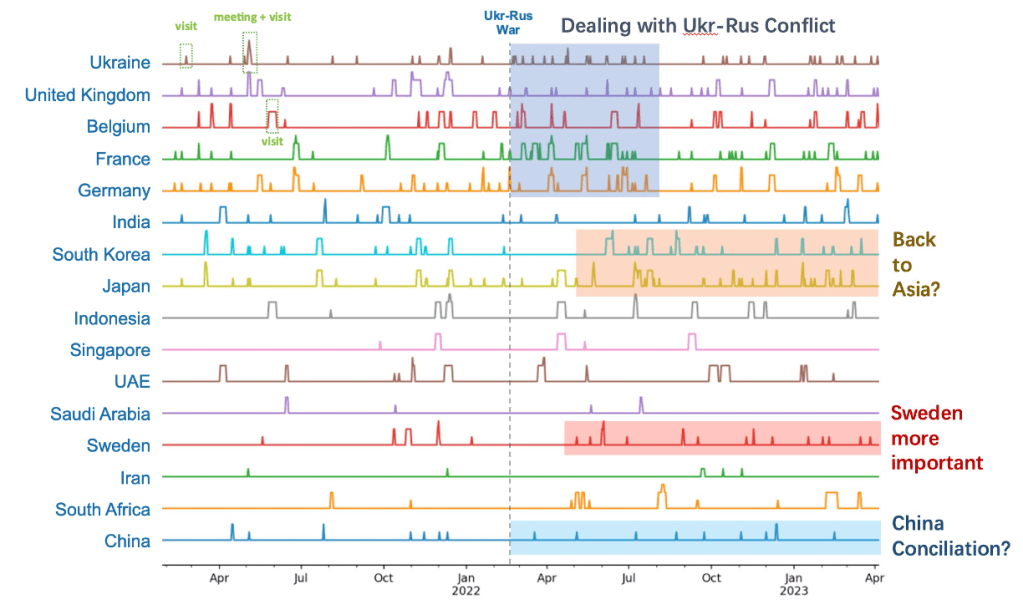
A major advantage of our database is its inclusion of activities from diplomats at various levels, enabling us to gather valuable future-related information from relatively lower-level diplomatic activities. While past research has mainly focused on ‘head-of-state diplomacy,’ such visits are often the culmination of many preceding activities. To fully understand these events, we need to pay attention to activities of lower-level diplomats, such as Deputy Secretaries of State, Assistant Secretaries, and special envoys. A good example is the visualization of American diplomatic activities in several key countries following the Russia-Ukraine conflict, which illustrates the impact of specific events on U.S. diplomatic actions and resource allocation. We can observe the pre-event diplomatic maneuvers based on intelligence, the post-event influx of diplomatic resources in Europe and among allies, and the U.S.’s return to its Asia-Pacific strategy following the event.
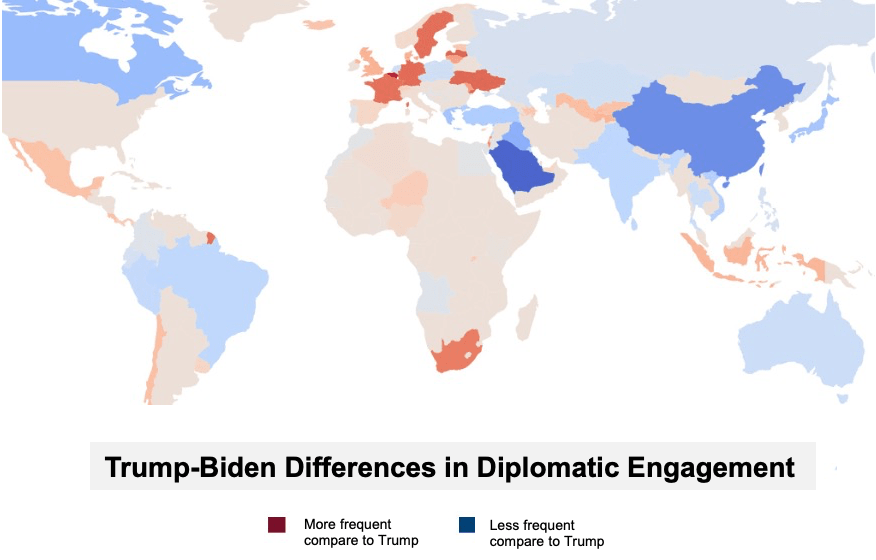
On a macro level, the differences in diplomatic strategies of different presidents can be showcased through big data. For instance, a comparison of the Biden and Trump administrations’ diplomatic activities reveals a noticeable decline in the Biden administration’s diplomatic activities in the Middle East, possibly linked to recent turmoil in the region.
Another strength of this database is the completeness of event information. We record not only the country visited and the names and times of the diplomats, but also the duration of stay, themes of visits, issues involved, and international organizations. Similarly, we have rich records of foreign visits. This information helps us better understand the specifics of particular events. Differences in the ratio of incoming and outgoing visits may also reflect changes in the nature of U.S.-foreign relations, as more frequent visits to a location can indicate a need for assistance. These differences can be demonstrated through our database.

We are committed to open source, a tradition in the computer industry that has promoted rapid technological development. We hope this approach will help more researchers engage in the emerging field of ‘big data in international relations.’ Below is the data of the Biden administration’s diplomatic activities until October 2022. We plan to open-source more in the future. If you find anything interesting or have suggestions, or if you wish to join this project, feel free to contact me at oliilo1986@icloud.com.
 Xin Tao's Blog
Leave a comment